
ecommerce.order_placed events.
Prediction attributes
Each scored customer gets these subscriber attributes. You can filter on them anywhere attributes work: segments, campaign targeting, and the API.
Because predictions are ordinary subscriber attributes, they appear on the
subscriber profile, in attribute autocomplete, and in subscriber responses
from the API, the CLI
(
sequenzy subscribers get), and the MCP get_subscriber tool - no special
endpoints needed.
Prediction attributes are managed by Sequenzy. You can read and filter on them
freely, but manual edits are overwritten by the next nightly refresh.
How the model works
The model is deliberately explainable rather than a black box:- Expected reorder interval blends the customer’s own median gap between orders with your store’s median. A customer with four or more observed gaps is scored mostly on their own cadence; a one-order customer starts from the store’s cadence.
- Repeat probability starts at your store’s repeat-purchase rate for one-order customers and rises with every repeat order the customer places.
- Churn risk combines repeat probability with how overdue the customer is: the survival score halves for every expected interval that passes without an order.
- Predicted spend multiplies a blended average order value (personal history weighted against the store’s predicted AOV) by the expected number of orders over the next year. It counts future spend only, so it can be lower than the customer’s lifetime value - a customer who already spent 40.
A brand-new customer can show a high churn risk minutes after their first
order. That is the store baseline, not a judgment of that customer: if only
15% of your customers ever place a second order, every first-time buyer starts
near 85% until a repeat purchase proves otherwise. The number drops sharply
after a reorder, and the at-risk segment and automation events only pick
customers up once they are actually past their expected next order date.
high for customers with 5+ orders, medium for 2-4, and
low for one-order customers - and never exceeds your store-level
forecast confidence, which depends on how
much order history the store has.
Eligibility
Predictions require the same baseline as the store-level commerce forecast: at least 20 orders from 10 customers, 30 days of history, 3 repeat customers, and an order in the last 45 days. Until your store qualifies, the Metrics dashboard lists exactly what’s missing.Predictive segments
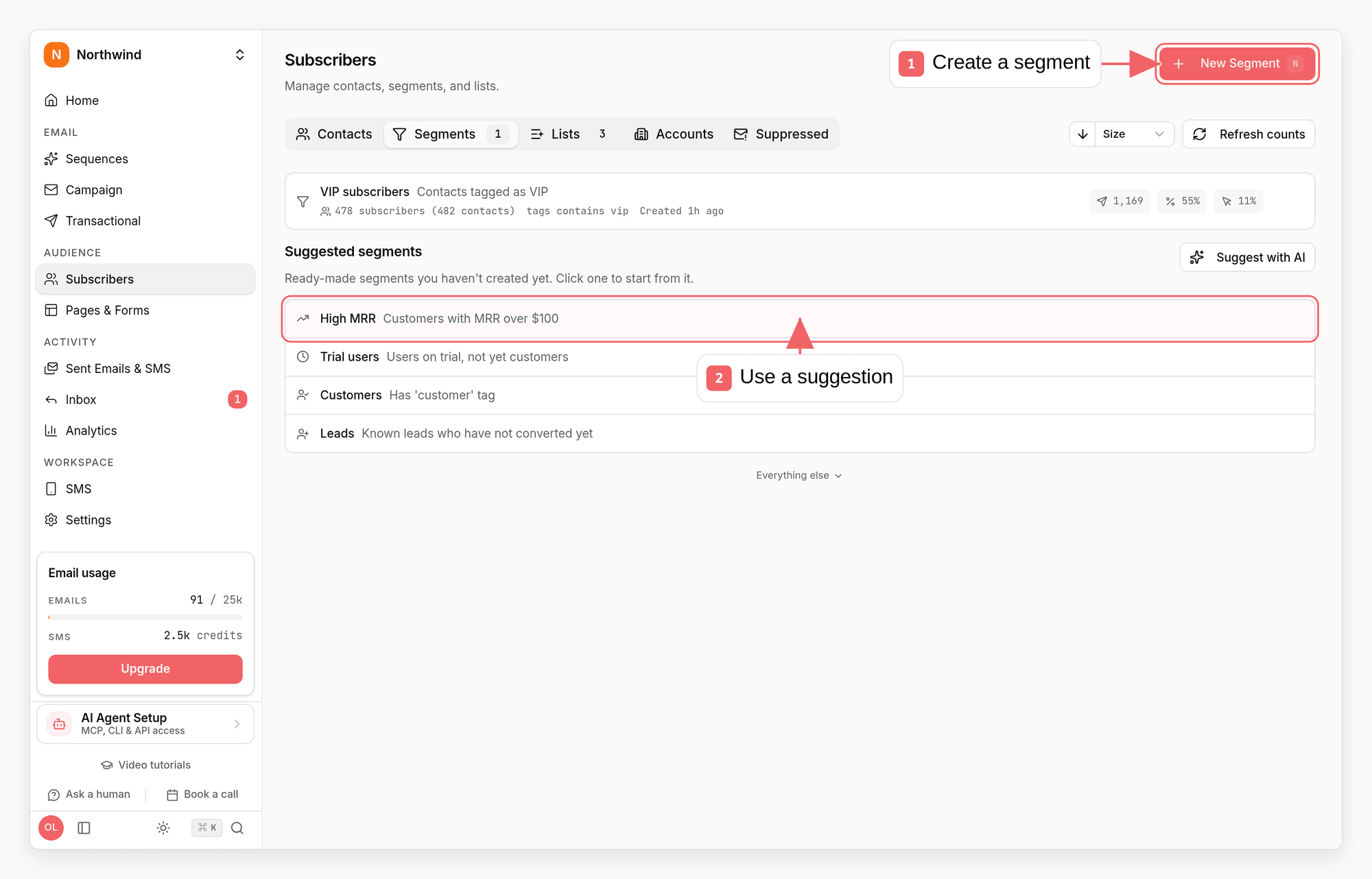
Three predefined segments are available out of the box under Subscribers → Segments → Suggested segments:- At-risk customers -
churnRisk >= 70andexpectedNextOrderAtbeforetoday, so first-time buyers who start at the store’s baseline churn risk are not flagged until they actually miss their expected reorder window - Predicted VIPs -
predictedLtv >= 200 - Due to reorder soon -
expectedNextOrderAtwithin the next 7 days
expectedNextOrderAt before today targets everyone overdue for
their predicted reorder.
Automation events
The nightly job emits two built-in events you can use as sequence triggers:ecommerce.reorder_window_missed- fires once per order cycle when a customer passes their expected next order date plus a grace period (25% of their interval, at least 3 days) without ordering. Ideal for winback sequences timed to each customer’s actual buying cadence instead of a fixed delay.ecommerce.churn_risk_elevated- fires when a customer’s churn risk crosses 70%. Ideal for at-risk offers before the customer is gone.
churnRisk, predictedLtv, orderCount, lastOrderAt,
expectedNextOrderAt, and currency properties for use in email content and
conditional blocks.
Events only fire for crossings that happened in the last couple of days.
Enabling predictions on a store with years of dormant customers never sends a
burst of late winback automations.
Store-level forecasts
The Metrics dashboard also shows store-level predictions - predicted AOV, 12-month customer value, and expected 90-day revenue with confidence ranges. Those are documented in the analytics API reference and available viaGET /api/v1/metrics, sequenzy stats, and the MCP get_stats tool.